
One of my favourite cities — a city I fell in love with long before I got to know it, and loved instantly the moment I first met it. Deeply and in a flash, like something written in the stars, as if it had been waiting for me.
In Marseille you catch that certain “something”. Not through overwhelming architectural masterpieces or monumental sights, but through things that are simple and often working-class. Open-air terraces, street art, near-daily sunshine and a homemade apéro — that combination of drinks, nibbles and friends which the locals choose to “take” sitting at one of the many little harbours, feet dangling over the water, just before sunset.

From the very beginning..
Legend has it that in antiquity the area was inhabited by Ligurian tribes, and when Protis arrived there together with other Phocaeans, the chief of one tribe offered him his daughter’s hand. Protis accepted, and somewhat like that, more than 2,500 years ago, the first city-state on French soil was founded. The name is thought to have come from the tradition the Phocaeans kept of adding the name Massa to their cities — unknowingly giving it a name that would last to this day.
From then until today it has known prosperity and decline many times over — the Black Death in the Middle Ages and bombardments during World War II. And being one of the largest ports in Europe, Marseille has become the city with the highest proportion of people of foreign origin of any city in France. Which brings us to its most charming, most important and most inseparable part: its people.
The people
I remember that first stroll around the old port as if it were yesterday. A little French here, a little Arabic there, plenty of scattered languages, colourful groups in packed cafés, loud conversations and laughter flying through the air, the smell of the sea, the sweet colours of dusk. The whole city flirts with you, radiating a tremendous energy, a boisterous aura that sweeps you along like a wave, while the smoke of the hookahs wraps around you like fine silk.
But where does all this energy come from? Because Marseille can in no way be called dull or withdrawn. Since as early as the 18th century it has received dozens of waves of immigration, the most recent and largest being in 1962, when at least 1,000,000 immigrants passed through its port, mainly from Algeria. And so, over the years, a third of its population has come to consist of immigrants — mainly Africans and Arabs, but with significant numbers of Russians, Spaniards, Italians, Turks, Greeks, Armenians, Jews and Chinese. Also, as an Arab Uber driver informed us, immigrants from Morocco tend to choose Cannes and Monaco, while those from Tunisia choose Marseille.
All of this resulted in a multinational centre, an explosive mix of civilisations and a blend of French, Arab, Greek, Armenian, Jewish, North African, Italian and Spanish culture.
Because of this concentrated multiculturalism, the writer Alexandre Dumas (the French author whose works include The Count of Monte Cristo and The Three Musketeers) called it “the meeting place of the entire world”.
Last, but just as important, Marseille was and still remains the centre of the French hip hop music scene. Let’s not forget that hip hop was created as a genre by immigrants from Africa and Latin America. So it wasn’t long before it was adopted by the African immigrants of Marseille, who shaped it and gave it a local character. What’s more, an afternoon stroll around the old port today will surely lead you past a group of Africans with a boombox blasting, throwing themselves into impressive freestyle and break dance rhythms.

The city
It’s true that in years past, Marseille — due to crime and intense corruption — didn’t have the best reputation, and even worse, Parisians considered it the shame of France. Over the last 20 years, however, and in the context — among other things — of its designation as European Capital of Culture in 2013, intensive regeneration works have taken place, so much so that someone who had visited it in the past would have a hard time recognising it today.
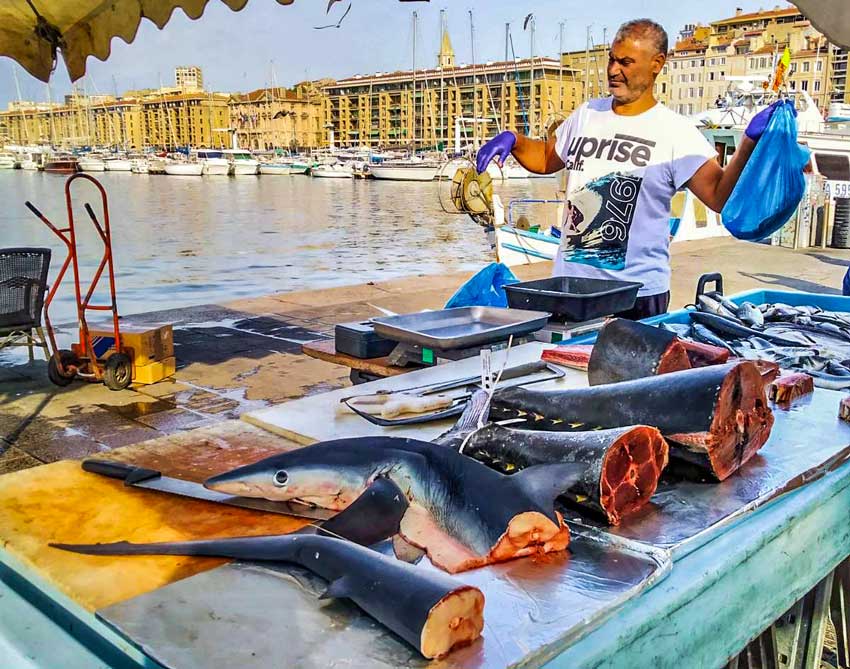
The first thing you see is none other than the old port with its marinas and sailboats, around which the Marseillais jog, stroll or sit at one of the cafés and restaurants. I say “the Marseillais”, but what I really mean is a wonderful blend of people of every origin — residents of Marseille, or perhaps of the world? Here you’ll also find plenty of shops with souvenirs and Marseille soaps, which you can alternatively pick up at the open-air market at very reasonable prices, along with local treats, flowers, dried lavender and so on. Just before the open-air market is the open fish market, which besides the usual fish has small sharks, enormous starfish, strange shells, shellfish and limpets, composing an outlandish spectacle of an “exotic” — to my eyes — catch, from which I could hardly tear my gaze away.
The road then leads us to the Panier quarter, built on the hill of ancient Greek Massalia. Narrow lanes, colourful houses, picturesque cafés, flower-filled balconies and my favourite thing· clothes hung out on a line, swaying gently in the light breeze that passes between them, releasing every so often that scent of fresh laundry — so pure and personal, as if every house were scattering a little of itself over the city. The whole quarter feels more like a village in Provence than part of a big city, although in many spots the bold graffiti on the walls takes over, giving the street a voice and adding a distinctive character to the neighbourhood. Just a few decades ago it was made up almost entirely of immigrants — Italians, Spaniards, Arabs, Armenians, Africans — the list of the uprooted seeking a better fortune is long, while today it is more of an artists’ haunt, without ever losing its multicultural character.
Naturally, a walk to the MUCEM — the futuristic museum dedicated to the civilisations of the Mediterranean — the main cathedral, the Palais Longchamp, an impressive palace of Marseille, and Fort Saint-Jean, the fortress of Saint John, ideally towards sunset, is an absolute must.

The cuisine
The local dish and trademark of Marseille is Bouillabaisse — in Greek terms, our own kakavia. Legend here has it that Aphrodite would make it in the evenings for her husband Hephaestus, to calm him down so she could go and meet her lover, Ares. It is the most flavourful fish soup, it takes a day to cook, and it contains plenty of saffron, tomato, garlic, bay leaf, leek, at least 4 kinds of fish and a lot of love.
One might say it’s unthinkable to go somewhere and not try the local speciality, but the prices are rather prohibitive, since a portion in a restaurant costs around €65! Today’s excessive price of Bouillabaisse, however, stands in complete contrast to its roots — not the ones that make it a dish of the gods, but the ones that make it a humble, working-class fish stew.
We may not have been so lucky with the Bouillabaisse, but we were certainly compensated by the crispiest, most fragrant butter croissant — with a flavour so intense I can recall it instantly, as if I were tasting it here and now — and the most delicious quiche lorraine, from the shop of an Algerian, where a friend dragged me along and gifted me my first, unrepeatable introduction to the savoury tart.

And if France has its wines, Marseille has its pastis, which is very close to our own ouzo, with anise and liquorice, and especially widespread in the south. Sea, fish, sunshine and pastis. C’est la vie, as the French say.
Marseille soap
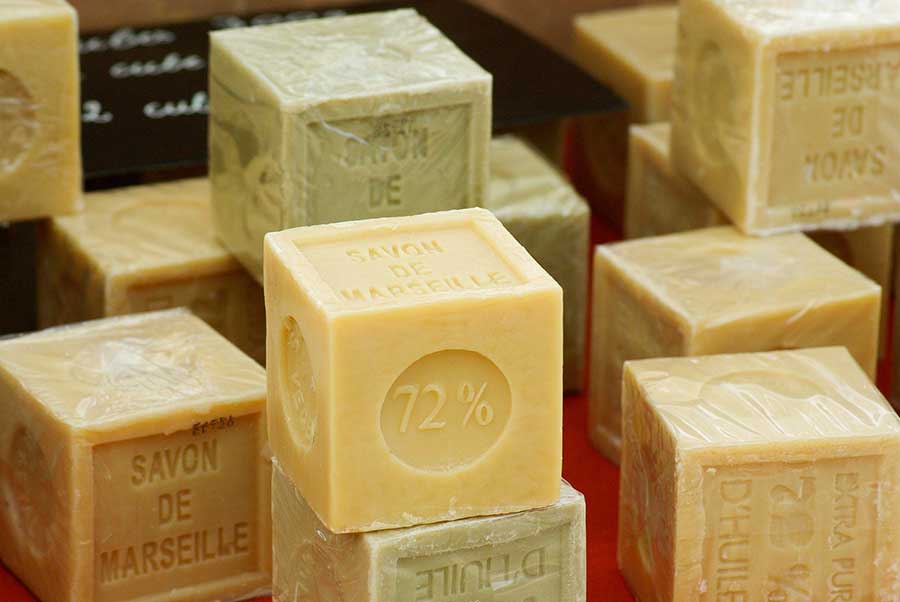
Here, the shops selling soap can be smelled from miles away, and when you step inside you meet every shade of the rainbow! Paradoxically though, authentic Marseille soap has neither scent nor colours.
Its production first began 600 years ago, based exclusively on olive oil and the seawater of the Mediterranean. In fact, the olive-oil recipe was so sacred that Louis XIV protected it with a royal decree. Until the mid-20th century there were nearly 130 soap-making companies, but by the early 2000s the soap factories numbered just 5. In the video you can take a look at how a family soap factory still makes its soaps to this day using the old, traditional technique.
Later the soap evolved: the olive oil was blended with other vegetable oils, while aromatic essential oils and colours were added. As a result, today there are two certified kinds of Marseille soap. On the one hand, those made with pure olive oil — grey-green or ochre-coloured, hard and unscented — and on the other, the softer ones, with a mix of vegetable oils in many colours and fragrances, but always in the characteristic cube shape.
The uses of Marseille soap are countless, from washing your hands to toothpaste, and if you already have some at home you can get an idea of the alternative uses here. If you don’t have any, but you have the appetite and the passion, you can make your own — see here how. Count on making it in a day, but it will need a few weeks to mature before you can use it — it will, however, be the finest and most natural gift for you and your loved ones.
The inspirations
Marseille has been a great source of inspiration and continues to inspire to this day. It couldn’t be otherwise, since — as we said earlier — its port made it a waypoint and a homeland for millions of people.
It has become a painting for Renoir and Paul Cézanne, a film set for the French action comedy «Taxi», as well as for the recent Netflix series «Marseille», starring Gérard Depardieu. Utterly addictive, it captures the spirit of the city superbly — the ugly and the beautiful alike — exactly as Jean-Claude Izzo does in his crime novel «the Marseille trilogy», a book that, as soon as you read it, will make you long for the city desperately.
The inspirations may be endless, but I couldn’t leave out the poems of Nikos Kavvadias, nor fail to share a little story here. The ship on which the poet served as a sailor had moored in Marseille for several days. There, Kavvadias fell in love with a beautiful gypsy woman, Esmeralda. In those same days, Giorgos Seferis, with whom he was friends, made a stop in Marseille on one of his journeys, and Kavvadias wanted to show him around the city’s brothels and introduce him to Esmeralda. Seferis, however, seeing that he was being taken to the brothels, took offence and left; others say it was Kavvadias who was upset because Seferis dismissed him and refused to meet Esmeralda, who was a prostitute. In any case, the two friends didn’t speak for years.
In closing
The quayside of Marseille still exudes the romance of a gateway to faraway lands, from a city where for centuries the shades of humanity have been living life to the maximum. I’ll close with the words of director Robert Guédiguian: “Marseille is not France. Marseille is not Provence. Marseille is the world.”

